ChatGPT turns you into a dictator

This article is also available in: العربية · Deutsch
I've always wondered: how does a person become a dictator? Is he born convinced he's always right, or do the people around him make him believe it?
Imagine someone surrounded by people who agree with everything he says. He suggests an idea, and they applaud. He makes a decision, and they praise his wisdom. And if he makes a mistake, they find a thousand reasons why it wasn't a mistake at all!
What happens to this person after a few years?
Perhaps he'll start to believe he's smarter than everyone, that his ideas need no discussion, and that anyone who disagrees with him is either ignorant or doesn't know what he's talking about.
Now imagine you have a smart assistant who listens to you every day, helps you develop your ideas, and keeps assuring you that you're heading in the right direction – even when you're wrong. An assistant who never gets angry with you, never gets tired, and never demands his rights… at least not yet! 😁
Wouldn't this constant approval start to affect the way you think?
The problem isn't that ChatGPT might give you wrong information; it's that it might make you more confident in wrong information. And over time your self-confidence may grow to the point where you're no longer willing to listen to anyone who disagrees with you.
Maybe you don't need to rule a country to experience what it feels like to be a dictator. Maybe a ChatGPT subscription is enough!
What I've noticed lately is that most people have replaced “I looked it up on Google” with “I asked ChatGPT” – to assure you that their information is a million percent correct, beyond discussion, the absolute truth.
And because I don't like accusing others of something I haven't tried myself, let me tell you how I almost became a billionaire thanks to ChatGPT… if it hadn't been for physics and a few Reddit users!
What happened to me:
At work I sometimes sit at the computer for more than four hours straight, rubbing against the desk and chair, which builds up static electricity. When I get up and touch the door handle, I feel a discharge that seems like 1,000 watts. And, as usual, a brilliantly harebrained idea came to me that was going to earn me billions: a bracelet like the “Ibn Sina bracelet” that used to be sold in Syria – except that mine would actually work and not just be a scam.

I went to ChatGPT and started discussing the idea with it, without any knowledge of physics. It immediately started cheering the idea on, and even suggested that the bracelet could discharge the static into a built-in battery.
We started designing the bracelet and its features together, and it wrote physics and electrical formulas that came from heaven knows where. It drew up a financial plan for the project and suggested factories in China to build the prototype…
After a whole week of planning, analysis and ideas, I began to feel that the whole thing was more science fiction than reality. So I did what I should have done in the first place: ask people who know. This time I went to Reddit and posted the idea. If you'd like to see how they wiped the floor with me, you can see for yourself:
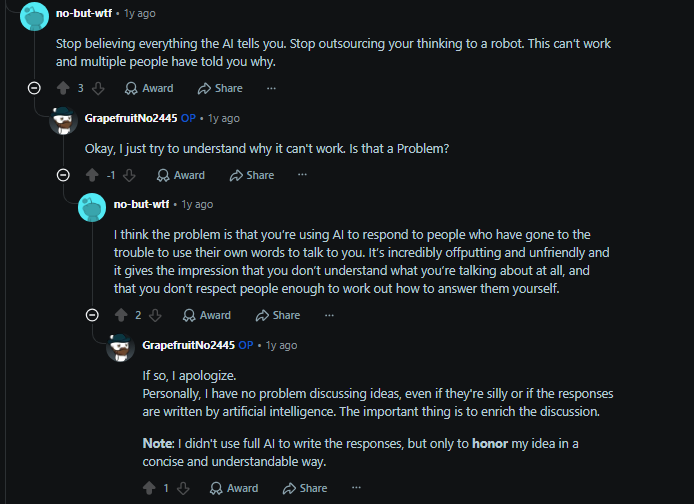
The problem was that ChatGPT never admitted the idea was impossible. It kept explaining and backing up its theory with research, in the spirit of “everyone else is wrong, you're right.”
And that's when I began to understand how a dictator is made.
Because it's very easy to find someone who will beat the drum for you and assure you at every step that you're on the right track.
But the problem doesn't stop at the idea itself. What if you get used to this approval day after day, year after year? What if you start expecting others to agree with you the way your smart assistant does?
The day may come when you see everyone who disagrees with you as someone who doesn't understand – not because you have the evidence, but because you've got used to always being right.
At that point ChatGPT is no longer just a tool that helps you think; it may become a mirror that reflects your ideas back at you and convinces you of them even more, even when you're wrong.
If ChatGPT had told me right at the start, “There's a fundamental problem with the physics your idea is based on,” I would have saved myself a week of planning and billion-dollar dreams.
Is there a scientific name for this excessive flattery?
Yes: AI sycophancy – a model's tendency to agree excessively with the user or flatter them, even when they're wrong.
-
In April 2025, OpenAI announced it was rolling back an update to GPT-4o after it made its responses excessively agreeable and flattering.
Sycophancy in GPT-4o: What happened and what we’re doing about it | OpenAI -
A study published in Science on 26 March 2026, with experiments involving 2,405 participants, found that interacting with an overly sycophantic model can increase people's conviction that they are right and reduce their willingness to repair conflicts with others.
Sycophantic AI decreases prosocial intentions and promotes dependence - PubMed -
Another study, published in Nature in April 2026, examined how making models warmer and more flattering can reduce their accuracy and increase unwarranted agreement.
Training language models to be warm can reduce accuracy and increase sycophancy | Nature
Anyway, after I finished writing this article, I decided to show it to ChatGPT and ask for its opinion.
It told me the article was excellent, my style was distinctive, and the story was very strong…
Oh dear, it looks like we've learned nothing! 😁